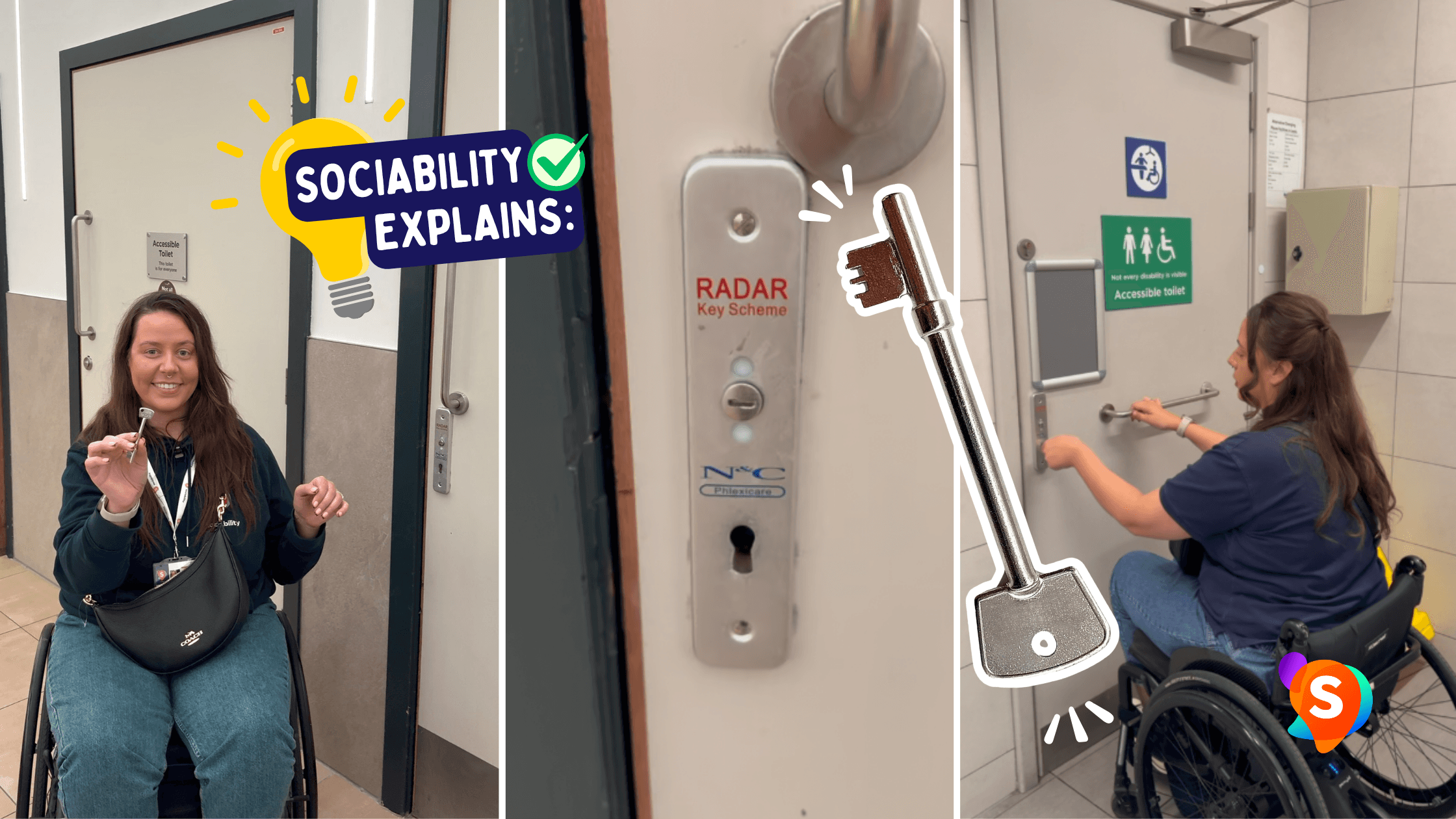
If you have ever come across a locked accessible toilet in the UK, there is a good chance it requires a RADAR key.
A RADAR key, also known as a National Key Scheme key, gives Disabled people independent access to thousands of locked accessible toilets across the UK. You will find them at train stations, shopping centres, public buildings, tourist attractions and many other places.
They are a small piece of accessibility equipment, but they can make a huge difference when you are out and about. Instead of having to find a member of staff and ask for a toilet to be unlocked, carrying your own key can give you quicker and more independent access.
Of course, getting through the door is only part of the picture. The accessibility of the space inside matters just as much. You can read our full guide to what makes a public toilet accessible to learn more about the features that can make a difference.
Want to see a RADAR key in action? You can also watch our RADAR key video on Instagram.
What is a RADAR Key?
A RADAR key is a large key designed to unlock accessible toilets that are part of the UK's National Key Scheme.
The scheme was introduced by the Royal Association for Disability and Rehabilitation, known as RADAR. The organisation later became part of Disability Rights UK, which continues to support the National Key Scheme today.
The National Key Scheme gives Disabled people a way to independently access accessible toilets that have been locked, rather than having to find a member of staff each time.
What does RADAR stand for?
RADAR originally stood for the Royal Association for Disability and Rehabilitation.
Although the organisation no longer exists separately, the name RADAR key is still commonly used.
You may also hear the same key described as:
a RADAR key
a National Key Scheme key
an NKS key
an accessible toilet key
What does a RADAR key open?
A RADAR key opens accessible toilets fitted with National Key Scheme locks.
You can find these toilets in places such as:
train and bus stations
shopping centres
supermarkets
cafés, pubs and restaurants
tourist attractions
public buildings
libraries
parks
council facilities
some public toilets
Not every accessible toilet in the UK uses a RADAR lock, so carrying a key does not guarantee access to every accessible toilet you come across.
Some toilets are left unlocked, while others may use a different system or require you to ask a member of staff.
Who can use a RADAR key?
RADAR keys are designed for Disabled people who need access to accessible toilet facilities.
You do not have to be a wheelchair user, and your disability or health condition does not have to be visible.
There are many reasons someone may need an accessible toilet. This can include people with:
mobility impairments
chronic illnesses
bladder or bowel conditions
conditions that make waiting for a toilet difficult
balance or fatigue problems
non-visible disabilities
other access needs requiring the additional facilities or space
It is important not to make assumptions about whether somebody "looks Disabled enough" to use an accessible toilet.
Different people need accessible toilets for different reasons.
Do you need proof of disability to get a RADAR key?
This can depend on where you get your key.
RADAR keys can be bought directly from Disability Rights UK, while some councils and local organisations also provide or sell them.
Individual councils may have their own eligibility rules, so it is worth checking your local authority if you would prefer to get one locally.
You can also buy an official RADAR key directly from Disability Rights UK.
Why are accessible toilets locked?
Many accessible toilets across the UK are kept locked and require a RADAR key to enter.
The National Key Scheme was introduced to give Disabled people a way to access these locked facilities independently, without having to find a member of staff each time.
However, a locked accessible toilet is still an additional barrier.
It means Disabled people may need to remember to carry a RADAR key, obtain one in the first place, or find a member of staff if they do not have one. A broken lock, missing key or inaccessible access system can also leave someone unable to use the toilet when they need it.
Accessible facilities should be easy to access when they are needed. While carrying a RADAR key can provide more independence within the current system, ideally Disabled people should not have to overcome an additional locked door to use an essential facility.
Why are RADAR keys useful?
For someone who regularly needs accessible toilets, carrying a RADAR key can remove a lot of unnecessary stress.
Having your own key can mean:
accessing the toilet yourself
not having to search for a member of staff
not having to explain why you need the accessible toilet
having one key that works with National Key Scheme locks around the UK
being better prepared when travelling
having more independence when out and about
This can be particularly important for people who need to use a toilet urgently.
If you have just arrived at a busy train station, for example, the last thing you want to do is spend ten minutes trying to find someone with the toilet key.
Does one RADAR key work everywhere?
A genuine RADAR key is designed to work with toilets using official National Key Scheme locks across the UK.
That does not mean the key will open every accessible toilet in the country.
A toilet may:
not be part of the National Key Scheme
be left unlocked
use another type of lock
require access through staff
have a faulty lock
It is more accurate to say that one RADAR key should work with RADAR or National Key Scheme locks around the UK.
Where can you get a RADAR key?
One of the easiest options is to purchase an official key directly from Disability Rights UK.
You can order a RADAR key from the Disability Rights UK shop here.
You may also be able to get one through:
your local council
mobility shops
disability organisations
some community organisations
online mobility retailers
If you are buying online, it is worth checking that you are buying a genuine key. Very cheap copies are widely available, but poorly made keys may not work reliably with every official lock.
How much does a RADAR key cost?
RADAR keys are generally inexpensive, although prices vary depending on where you buy one.
Rather than relying on an old price, check the Disability Rights UK RADAR key shop or your local council for the latest cost.
Some councils may also provide keys free or at a reduced cost to eligible residents.
Can you use a RADAR key if you have an invisible disability?
Yes.
You do not need to have a visible mobility impairment to need an accessible toilet.
Accessible toilets can be important for people with many non-visible disabilities and health conditions, including conditions that affect continence, fatigue, pain, balance or how urgently somebody needs to use a toilet.
This is why nobody should be challenged simply because they do not "look Disabled".
Access needs are not always visible.
Is a RADAR toilet the same as a Changing Places toilet?
No.
A standard accessible toilet and a Changing Places toilet are different facilities.
Changing Places toilets are designed for people who need more space or additional equipment than is available in a standard accessible toilet. They typically include features such as an adult-sized changing bench, hoist and enough room for the Disabled person and anyone supporting them.
Some Changing Places toilets may use RADAR keys or other access systems, but having a RADAR key does not mean a standard accessible toilet will contain Changing Places equipment.
You can find out more about the features that matter in our guide to what makes a public toilet accessible.
Does having a RADAR key mean the toilet will be accessible to you?
Unfortunately, no.
This is one of the biggest problems with using a single word like "accessible".
Two accessible toilets can be completely different.
Depending on your access needs, you may need to know:
how wide the doorway is
whether access is completely step-free
how much transfer space there is beside the toilet
whether transfer is on the left or right
whether grab rails are available
whether there is a lowered sink
whether an emergency cord is present and within reach
whether there is enough turning space for your wheelchair
whether the door is heavy
whether equipment or furniture is obstructing the space
A RADAR key can unlock the door, but it cannot tell you whether the facilities on the other side will work for you.
That is why detailed accessibility information is so important.
What should you do if your RADAR key does not work?
If your key does not unlock a toilet, do not assume that your key is necessarily the problem.
The lock itself may be damaged or faulty.
If you are in a staffed venue, speak to a member of staff and let them know there is an issue.
For council-managed public toilets, there may be contact information nearby for reporting faults.
If your key regularly fails to work in different locations, it may be worth replacing it with an official RADAR key.
Tips for using a RADAR key
There are a few simple things that can make carrying and using your key easier.
Keep it somewhere easy to reach rather than at the bottom of your bag.
Attach it to a distinctive keyring or lanyard so you can find it quickly.
Knock and check whether the toilet is occupied before unlocking the door.
Check any red or green occupancy indicator before entering.
Report faulty locks or inaccessible facilities when you encounter them.
Consider keeping your RADAR key permanently in your handbag, backpack or wheelchair bag.
It is one of those small accessibility tools that can be incredibly useful to always have with you.
Can you use a RADAR key outside the UK?
The RADAR National Key Scheme is a UK system.
Other countries may have their own accessible toilet schemes or key systems, so it is worth researching what is used at your destination before travelling abroad.
If you are planning a trip, do not assume your UK RADAR key will work internationally.
Find accessible toilets and places before you visit
Having a RADAR key can help you access a locked toilet, but knowing what the facilities are actually like before you arrive can make planning much easier.
Sociability helps Disabled people find detailed accessibility information for cafés, restaurants, bars and other places across the UK.
Instead of simply telling you that somewhere is "accessible", Sociability lets you look at the individual features that matter to you so you can decide whether a venue works for your own access needs.
Download the free Sociability app to explore accessibility information before you visit.
You can also add places, photographs and accessibility information yourself, helping the next Disabled person planning where to go.
And if you want to see exactly what a RADAR key looks like and how it works, watch our RADAR key video on Instagram.
RADAR Key FAQs
Can anyone buy a RADAR key?
RADAR keys are intended for Disabled people who need access to accessible toilets. Official keys can be purchased through Disability Rights UK, while councils and other organisations may have their own local arrangements.
Do you have to be a wheelchair user to have a RADAR key?
No. People with many different disabilities and health conditions may need accessible toilet facilities, including people with non-visible disabilities.
Does a RADAR key open every Disabled toilet?
No. It opens toilets fitted with National Key Scheme locks. Not every accessible toilet uses the RADAR system.
Where is the best place to buy a RADAR key?
You can buy an official RADAR key directly from Disability Rights UK. Some councils and mobility retailers also supply them.
What does RADAR stand for?
RADAR originally stood for the Royal Association for Disability and Rehabilitation, the organisation that introduced the National Key Scheme.
Is a RADAR key the same as an accessible toilet key?
Usually, when people in the UK refer to a RADAR key or accessible toilet key, they are talking about a key for the National Key Scheme.
Can I use my RADAR key across the UK?
A genuine RADAR key is designed to work with National Key Scheme locks around the UK, although not every accessible toilet participates in the scheme.
Final thoughts
A RADAR key may be small, but it can remove a significant barrier for Disabled people.
Being able to unlock an accessible toilet yourself means less waiting, less searching for staff and greater independence when travelling, socialising or simply going about everyday life.
But accessibility does not stop at the lock on the door.
The layout, equipment and condition of the toilet itself still determine whether it is actually usable for an individual Disabled person.
That is why detailed access information matters.

Sociability
Sociability is a disability-led social enterprise dedicated to making the world more accessible through accurate, verified data. Our team combines lived experience with technical expertise to help individuals and organisations navigate and improve accessibility information across the UK.